Tyler Gindraux

I’m Tyler, a service designer in Brooklyn. I help organizations cut through complexity and make change stick.

Past work

All past work

    What it’s like to work with me

    All testimonials

    Recent writing

    All writing

      Get in touch

      I’d love to hear about your team, the services you’re working on and the outcomes you’re building towards.

      Email me at [email protected] or find me on LinkedIn.

      Work

      Research and service design from discovery through implementation.

      Projects

      Newest first
        All work

        Helping Veterans get the answers they need

        Veterans sent VA 500,000 questions last year through Ask VA, a contact form with up to 42 fields. My focus was working out which information we could remove, and building a compelling case for why.

        Client
        U.S. Department of Veterans Affairs, with Blue Tiger
        My role
        Lead researcher and designer
        Dates
        2023 to 2025
        Methods
        Competitor analysis, service mapping, usability testing, workshops, data analysis
        500,000questions sent to VA through Ask VA in a year
        42fields a Veteran might fill in to ask one question
        50+stakeholders, each with a vote on changes to the experience

        The problem

        Service
        Ask VA, a contact experience that lets Veterans ask questions about their benefits and healthcare
        Problem
        The contact form asks for up to 42 fields of information
        Goal
        Make it simpler to contact VA

        Something unusual about this contract: more than 50 VA stakeholders get to vote on any change to the user experience. Any simplification had to win them over.

        What we needed to learn

        Our starting assumption was that users are frustrated by the length of the process, which many stakeholders had added to over time. To test it, I set two questions:

        • Which questions cause the most confusion for users?
        • What do staff actually need to answer a Veteran’s inquiry?

        How I approached it

        Based on our timeline, goals and resources, I chose five methods, each with a job to do.

        1. Competitor analysisSet a North Star and vision
        2. Mapping the serviceSpot potential opportunities
        3. Usability testing with VeteransFind the pain points across journeys
        4. Workshops with business usersUnderstand constraints
        5. Data analysisVerify at scale and build the case

        Setting a North Star

        I reviewed eight similar contact forms from companies like Grammarly and Con Edison. They asked about 6 questions, against VA’s 42: 86% more questions to contact VA.

        We worked this into a set of KPIs, which gave stakeholders a concrete benchmark and showed why simplification was necessary.

        Mapping the service

        I created journey and integration maps to understand the current service across three layers:

        • User experience: from starting the form to receiving help
        • Staff workflows: how inquiries are routed across 18 departments
        • Backend systems: which fields feed into which processes

        The maps let us assess how the service really works and what we could change.

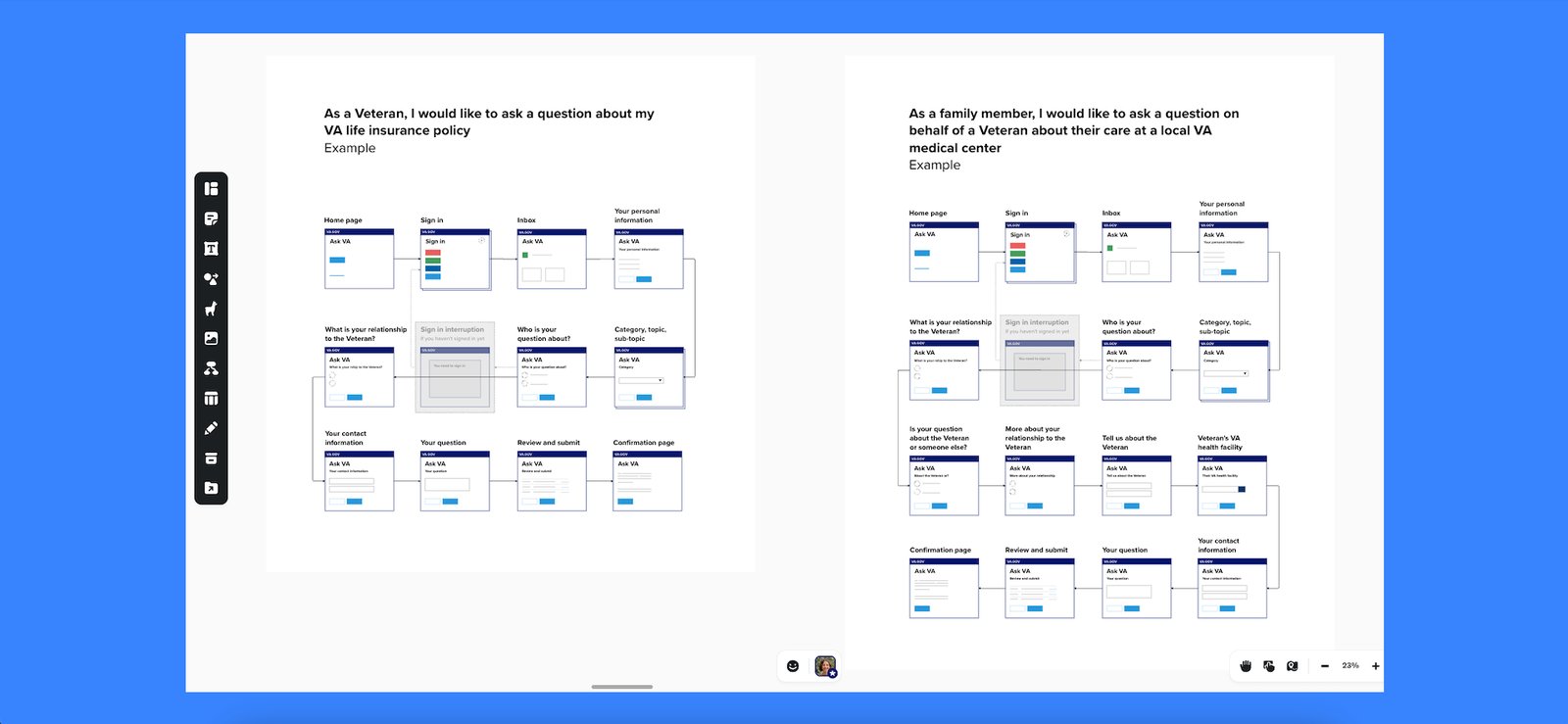
        Ask VA example user flows diagrammed in Mural
        Example user flows for Ask VA, diagrammed in Mural

        What we learned from Veterans and staff

        Veterans

        Usability testing with 30+ Veterans

        • Frustrated by questions about pronouns and gender; most choose “prefer not to answer”
        • Strong concerns about who will see their sensitive information
        • Surprised by how much information was required; many would abandon the form early

        Business users

        Workshops and observation across 18 business lines

        • Fields like gender, military ID and employee status aren’t needed to reply
        • Too much information in the system slows response times
        • Business lines have voting power on the changes we make

        The pain points aligned: Veterans want to answer fewer questions, and staff waste time wading through information.

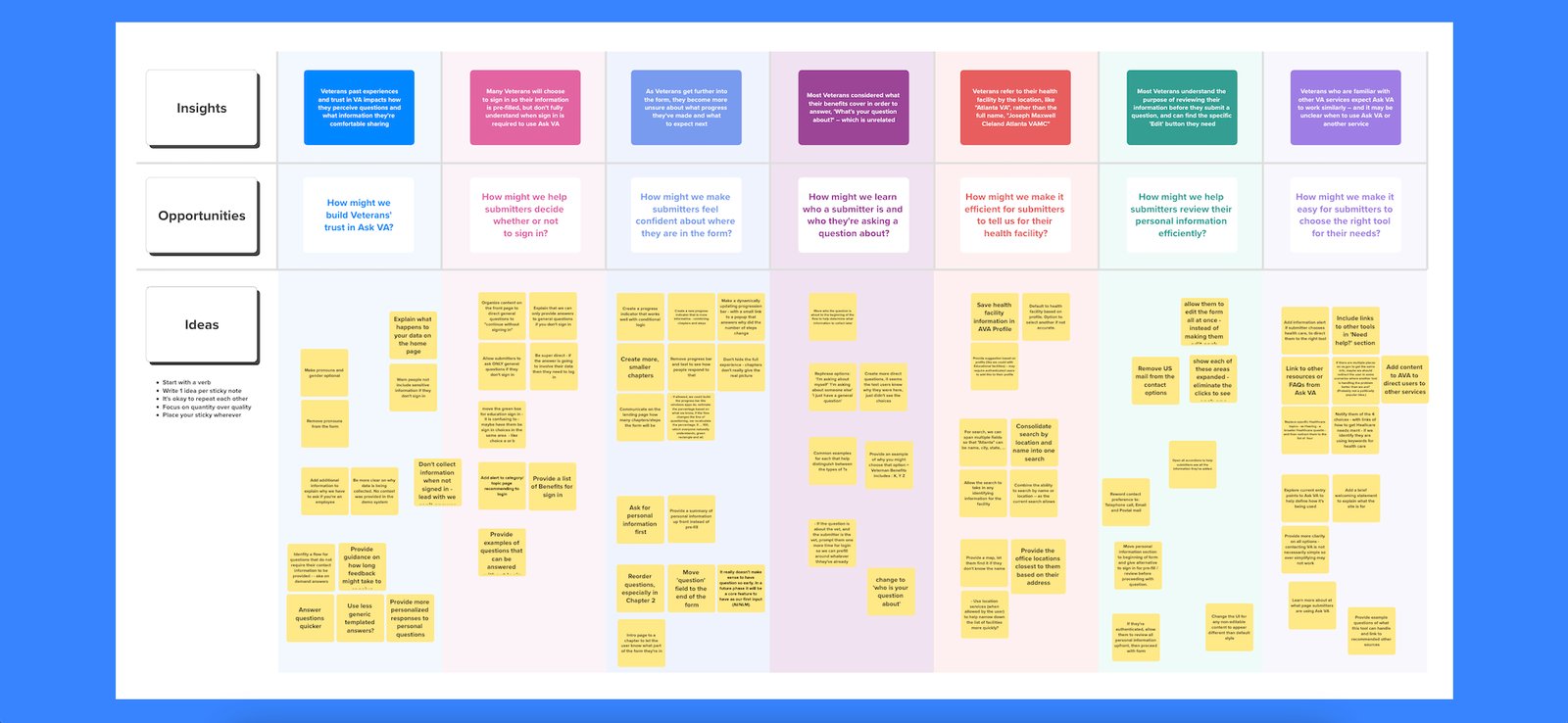
        Whiteboard used to facilitate a workshop about insights, opportunities and ideas
        Whiteboard from a workshop on insights, opportunities and ideas

        Testing our findings at scale

        With a data scientist on my team, I checked whether what we heard from small samples held true at large. One example: the gender field.

        70%of people selected “prefer not to answer”
        1%of the time, the answer told VA something it didn’t already have on record

        We were asking a question that frustrated users, wasn’t needed to reply, and gave us new information just 1% of the time. Qualitative insight plus behavioral data made a far stronger case for removing it.

        “Somebody’s gender identity shouldn’t have any bearing on VA benefits.”
        Veteran, user research

        Winning over 50+ stakeholders

        • I presented to more than 50 stakeholders, alongside our client, the Product Owner at VA.
        • I layered the evidence: competitor benchmark, user research, staff workshops and quantitative data.
        • Stakeholders voted in favor of the changes we proposed, despite their initial resistance.

        Impact

        20fewer questions when the new form launched in 2025
        18VA departments we built stakeholder partnerships with
        • A simpler experience for Veterans, with up to 20 fields removed
        • Simpler staff workflows, by limiting the data VA collects
        • A North Star vision for future improvements, including AI-assisted answers that help people without submitting a question
        “Tyler doesn’t just check all the boxes (empathy, rigor, creativity, attention to detail), she somehow finds a way to make new, better boxes you didn’t even know you needed.”
        Program Manager
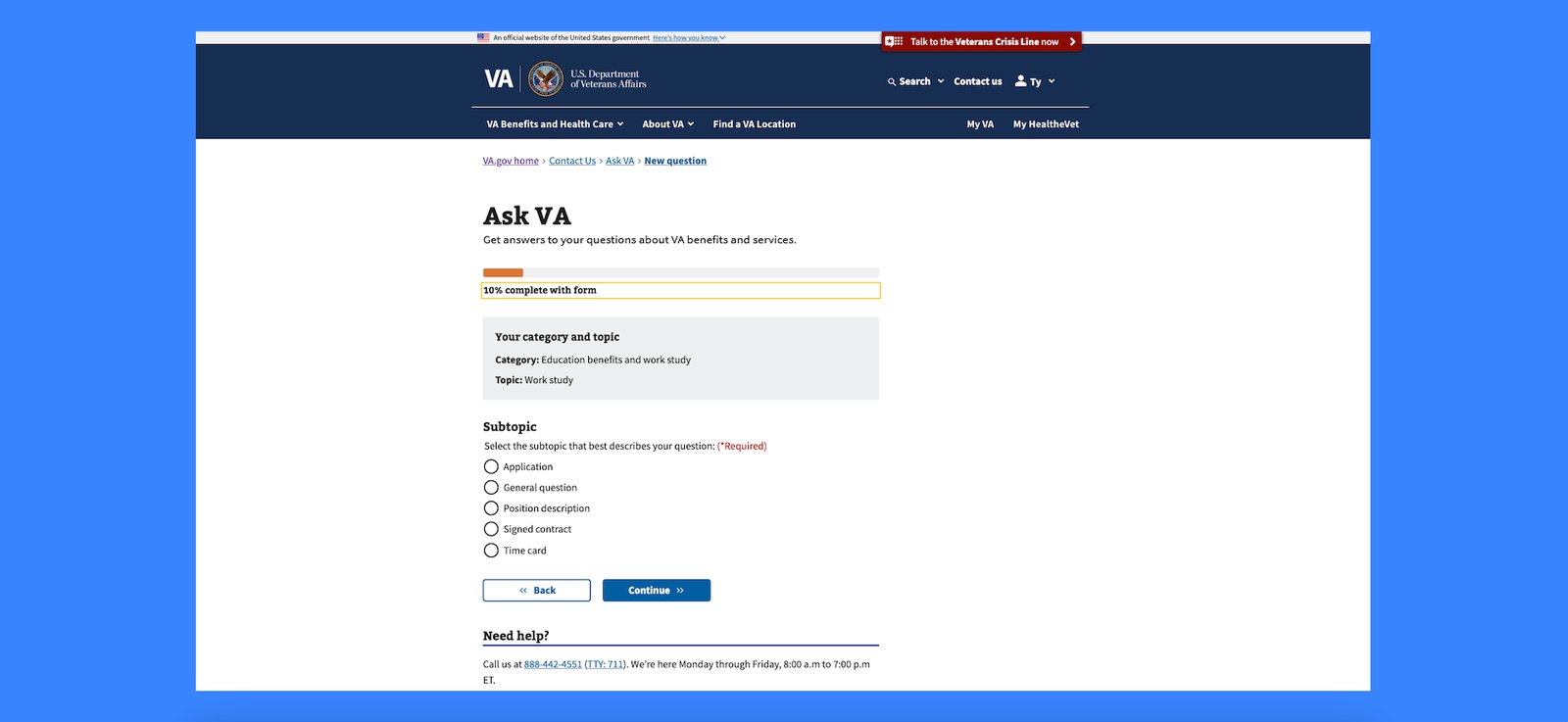
        The redesigned Ask VA interface on VA.gov
        The new Ask VA experience on VA.gov

        Reflection

        • Quantitative data and triangulation were key to influencing 50+ stakeholders.
        • Understanding staff workflows was critical to improving the end user’s experience.
        • Building relationships is often key to gathering insights and moving work forward.

        Next time I would

        Bring stakeholders together even earlier. Seeing how large the service is, and how many needs sit on the staff side, helps people understand why compromise matters.

        All work

        Making it easier to do business with the State of Maryland

        Small businesses in Maryland deal with each state agency separately, with different sign-ins, websites, tasks and requirements. I’m leading the work to map that landscape and recommend how to simplify it.

        Client
        Maryland Economic Development Corporation (MEDCO)
        My role
        Lead service designer, leading a small team and the client relationship
        Dates
        2026 to present
        Methods
        AI-assisted desk research, interviews, agency workshops, service blueprinting
        697,000small businesses in Maryland, each piecing together requirements across agencies
        2%of business records matched between two of the main agencies
        26recommendations, each with a first step and a long-term plan

        The problem

        Service
        Registering and filing as a business in Maryland
        Problem
        Businesses deal with each agency separately, with different sign-ins, websites, tasks and requirements
        Goal
        Map the current landscape and recommend opportunities to improve the experience

        MEDCO sits outside government and works to improve economic development in Maryland. We looked at how small businesses navigate registration, tax and employment filings across state agencies.

        What we needed to learn

        • What does a business have to do across agencies, and in what order?
        • Where do businesses get stuck, and where do they turn for help?

        How I approached it

        1. AI-assisted desk researchAI helped triage hundreds of pages of statutes and agency instructions, and the team checked everything it produced
        2. Interviews with 5 businessesIncluding a winery director, a benefits broker and a brand new AI business, to hear from new and established businesses
        3. Workshops with agenciesIncluding SDAT, the Comptroller, Labor and DoIT, to test and add to our desk research

        Mapping the service across agencies

        I used our findings to map the service end to end and front to back:

        • User experience: from forming a business to maintaining ongoing filings and requirements
        • Agency processes: how each agency handles the same business, and what it collects
        • Systems and data: where information moves between agencies, and where it doesn’t

        Every agency told us it was the first time they’d seen their part of the service next to everyone else’s.

        Bringing the research to life

        Requirements vary a lot depending on what a business does and how far along it is, so I created journey maps for two contrasting personas.

        Arthur and Clara open a technology LLC

        Neither has started a business before. They’ll have no physical office, sell digital services in and outside Maryland, and employ 30 people who live in 5 different states.

        Devon maintains a beer and wine store

        A sole proprietor in Allegany County for 4 years, with 12 employees. He juggles state, county and city tax accounts, several licenses and permits, and files monthly, quarterly and annually.

        What businesses and agencies told us

        Small businesses

        • Can’t tell whether they’ve found every requirement that applies, so they turn to AI
        • Keep their own notes to get through filings they’ve done many times
        • Accounts are built for individuals, so co-owners share passwords

        Agency staff

        • Each agency built its own “single front door,” so now there are several
        • Data isn’t shared: SDAT and the Comptroller match only about 2% of business records
        • Fixes stall without clear ownership

        Businesses do the work of piecing government together. When state websites contradict each other, AI tools blend them into one confident, incorrect answer. The problem isn’t only too many websites; there’s no reliable source underneath them.

        “Claude […] is faster. I could look at Maryland websites [myself] and I could miss or not see this one that might have additional information.”
        Small business owner

        Recommendations changed as we tested

        Draft idea

        Make Maryland Business Express the single source of truth

        Agencies pushed back, and disagreed with each other on whether one website was the answer

        Final recommendation

        Each agency keeps its information accurate at the source; other sites and AI tools pull from it

        Solves the business’s problem without a new portal, and recognizes new ways people search for information

        Halfway through, we shared draft ideas so agencies could react to something concrete. To sharpen them, I:

        • asked agencies what would get in the way of each idea we drafted
        • tested draft ideas with small businesses to check what mattered most
        • facilitated a workshop where agencies scored value and complexity

        A pilot to carry ideas forward

        Agencies told us many of these problems aren’t new, and they feared nothing would change. So alongside our recommendations, we’re designing a pilot focused on the seams between agencies.

        26recommendations, each with a first step and a long-term plan
        12month pilot on one journey, to test state capacity, staffing and improvements
        5fixes prioritized in the pilot, at high-impact moments that cross agency boundaries
        Forming an LLCRegistering for taxesHiring a first employee

        “I’ve started my business and hired my first employee. Am I set up correctly?”

        Reflection so far

        • Look for who carries the hand-off burden: that’s often where the design opportunity is.
        • Build relationships early, and use that trust to bring ideas or concerns to the surface.
        • Rely on AI assistance for desk research and as a memory tool throughout discovery.

        From our client

        “A lot of people will just write a report and hand it over at the end, but the fact that we’re going through this process and getting feedback and making sure that folks are on board is huge. You’re getting buy-in from agencies.”

        Client at MEDCO

        All work

        Deciding the purpose of an online community

        Leadership at a national charity had ideas for a new online community, but no user input or clear direction. I led research that turned many opinions into a product direction grounded in user needs.

        Employer
        Royal National Institute for Deaf People (RNID)
        My role
        User researcher and service designer
        Dates
        April to June 2022
        Methods
        Assumption mapping, interviews, concept testing, service blueprinting
        18 millionpeople in the UK who are deaf or have hearing loss
        10participants across user segments, with sign language interpreters at every session
        4concepts tested to find which interactions resonated

        The problem

        Service
        An online community platform for RNID
        Problem
        Leadership had product ideas, but without user input or clear direction
        Goal
        Define user needs to inform a product strategy

        RNID’s new strategy included helping people connect with each other online. When leadership briefed our design team, there were many assumptions about what the product should be, and none had been checked with users.

        Aligning the team before research

        With many stakeholders holding strong opinions, I ran an early activity to separate what we actually knew from what we didn’t.

        We know

        • It should help deaf people and people with hearing loss
        • Solutions need to be accessible for people who use sign language

        We think

        • It should help people connect to expert advice
        • People want to interact across user groups

        We’re not sure

        • Whether people prefer groups or one-to-one
        • How people will feel interacting with people who are different to them
        • How accessible existing solutions are

        We don’t think

        • People should have to pay for help

        It separated assumptions from validated insights and set the questions to answer. Stakeholders also agreed research was needed: there were too many open questions to build on assumptions.

        How I approached it

        Key questions to answer:

        • How do people currently connect with others online?
        • What types of interactions do people expect to have with other people online?
        • How do people expect to be kept safe on a community platform?
        1. User interviewsTo learn current behaviors, platforms and expectations
        2. Concept testingLeadership already had ideas, so this wasn’t pure discovery. Concepts let us test which types of interaction resonated and choose a direction
        3. 10 participantsRecruited across user segments, with sign language interpreters hired and prepped for every session

        Four concepts to test

        With a product designer, I created four concepts, each based on a familiar model from social platforms or sites like WikiHow.

        Share your story

        How-to guides

        Ask and learn

        Find products, events or services

        What we learned

        • People want an informal space to share experiences, not expert advice.
        • They need ways to find others with similar experiences and backgrounds.

        This was about connection and empathy, not how-to guides, and it differed from most of RNID’s other products. It fundamentally shaped how we thought about the product.

        “If I can share my experiences with hearing loss, I’d probably find those experiences are actually a lot more common than I realize.”
        Research participant

        Making the direction tangible

        With our findings and a workshop with key stakeholders, I developed a future state service blueprint covering user and staff activities, capabilities, technology and data across four stages.

        DiscoverJoinEngageLeave

        Impact

        Initial assumption

        Expert advice and how-to guides

        Vision after research

        Peer connection and shared experience

        • Shifted stakeholder assumptions from expert advice to peer support, and leadership approved the product direction.
        • Delivered a service blueprint and a platform evaluation framework.
        • Recommendations became product strategy: the insights became criteria for build or buy, feature priorities and how to measure success.

        Reflection

        • Concept testing helps focus ambiguous discovery and defines a clear direction early.
        • Aligning on assumptions frames objectives, minimizes risk and shows whether research is needed to make strategic decisions.

        Next time I would

        Lead a diary study to follow real behavior on platforms people already use, like Facebook groups.

        “I learned so much from Tyler about user research, service design and people more generally. She has a way of making people feel confident when working together.”
        Designer

        Writing

        I write about service design, user research, accessibility and participatory practice.

        All writing

        Good research reveals a strategy

        June 11, 2025

        User research is about more than testing whether a design works. Insights from research should help teams make strategic decisions, like what we’re building and why, our technical approach, product-market fit and even how we sequence and prioritize work.

        Technical capabilities don’t guarantee we meet user needs

        At the U.S. Department of Veterans Affairs, my team recently replatformed Ask VA to VA.gov. Ask VA lets Veterans and their support networks ask the VA a question online.

        Currently, submitters have to choose a category, topic and subtopic to determine which department should receive their question. Despite the usability and content improvements we made based on research, we know this categorization is still difficult and time-consuming.

        Last year, our VA Product Owner and data engineers started building a natural language processing (NLP) model to predict these categories from someone’s question. The hypothesis: by pre-filling these selections and letting submitters review the predictions, we could reduce burden and improve the experience.

        It’s an exciting idea with real potential. And there’s an opportunity for research to help shape how the technology is implemented.

        Technical capabilities alone don’t guarantee we’ll meet user needs.

        Research insights drive strategic decisions

        I proposed a study to test early concepts with Veterans, so we could understand how an NLP model should surface predictions. We tested different prototypes, for example a single prediction versus a list of options.

        We learned that people prefer choosing from a list of narrow options rather than the tool jumping to a conclusion. And while people are good at spotting when a suggestion is wrong, it’s difficult to choose the correct option without further explanation.

        These insights drove our approach. Alongside data engineers and our UX designer, we developed a solution: show one or more options that the model is really confident about.

        If the model is very confident in one option and not at all confident in the rest, we choose for the user. If it’s fairly confident in a few options, we let the user choose from that short list. This balances choice (which people want) with reducing cognitive load (which is our goal), while avoiding suggestions the model isn’t confident about.

        Our team could have made assumptions and invested months into a complete solution built on technical capabilities. Instead, we took a step back and asked how technology should interact with people to solve their problems.

        This kind of strategic research should happen early and often, when teams are exploring what to build, why, and how it should work. When research is a strategic partner from the start, teams make decisions guided by user needs rather than assumptions, and build products that actually work for people.

        All writing

        The pressure to use AI for everything, everywhere, all at once

        Recent advances in AI have been dramatic, and AI adoption is more ubiquitous than ever. It’s undoubtedly a powerful technology and a tool worth having in our toolbox. But I’ve noticed a troubling trend towards, “find a reason to use AI and then go pilot.”

        Rather than identifying a problem as the starting point, this approach centers a solution. There are times when this may work, but more often than not, solutions in search of a problem can be harmful. And without a focus on outcomes, we’re forcing AI solutions onto problems where AI may not be the best, or only, answer. As GOV.UK's Service manual identifies, “More established technologies might solve the problem better than AI.”

        Even when projects include a fair focus on discovery, the solution space is often now constrained by the required use of AI. Take the Public Benefit Innovation Fund (PBIF)’s Summer 2025 open call, which allocated funding specifically for “AI solutions that address pressing public benefit challenges.” While well-intentioned, this funding structure exemplifies this trend: it centers AI as the required solution rather than centering challenges themselves.

        Between dedicated AI funding streams like PBIF’s, executive mandates to ‘innovate with AI,’ and the fear of being left behind, there’s pressure to deliver AI. While I appreciate the value AI can bring to plenty of service issues, I’m concerned that we’re taking 10 steps back when we structure our work around AI delivery rather than outcome delivery. “When you have a hammer, everything looks like a nail” has never been truer.

        In addition to producing technical debt, this approach prevents teams from seeing the larger picture of solutions, of which AI might be one or some, but very likely is not all of them. AI that helps you fill out a long form could be helpful, but perhaps the better solution is to have a shorter form (which actually requires policy changes, stakeholder alignment, and content design). When we start with AI as the solution, we miss these deeper interventions that could solve the root problem.

        And as Mickin Sahni, Director of Product & AI Lab Lead at Ad Hoc wrote recently, you have to be willing to “accept that you might discover AI didn’t solve the problem.” To me, this acceptance doesn’t show failure or poor foresight. It shows maturity, honesty and an understanding of how the technology actually works. It means that when you do find success with a solution that involves AI, you can trust that it does. Because, as Sahni emphasizes, you know you’re measuring the right things and you’re being honest in your assessments.

        How do we actually do this? As a service designer, I start by asking good questions to understand services and the processes that support them, meeting users and staff who deliver services to help us identify specific problems. Then I facilitate conversations to hypothesize and test a variety of solutions. I can embrace a solution that involves AI when it’s the right fit. And I help others recognize when the solution is more focused on people or process than technology. Sometimes the best solutions are staff training, process changes, or a simpler form.

        The pressure to use AI for everything, everywhere, all at once won’t last forever. What will remain is the need to solve real problems for real people. And true innovation begins when we commit to solving the right problems instead of deploying the trendiest solutions.

        All writing

        Comparing services to inform a product vision

        A comparative analysis is a method of identifying similarities and differences between designs, products or services. It's often used to identify best practices and make decisions.

        I'm not a big fan of this method. Let me explain why.

        Similar to personas, comparative analyses are often completed so that teams can check off a required step in the design process. You do the exercise, share your findings, and then, very often, the artifact collects dust.

        Like any research or design method, a comparative analysis is only helpful if you're clear about why you're doing it. And sharing findings might be a step, but it's not an outcome.

        Defining outcomes that matter

        At the right moment, a comparative analysis can be a useful artifact to provoke thought. It's easier to look at something and say what you like or don't like about it, than it is to come up with a product vision starting from scratch. This is particularly true when you bring together a group of people who have different ideas of what a service is, does or could do.

        At the U.S. Department of Veterans Affairs, my team recently replatformed Ask VA to VA.gov. Ask VA lets Veterans and their support networks ask the VA a question online.

        Since launching, we've been having conversations about the future direction of Ask VA. We want to create a product vision in collaboration with our partners. And to do this, we need to articulate the things we like or don't like about the current product and the direction we recommend.

        I started by writing research goals. To understand how we could meet expectations and provide a more effective service, I planned to compare Ask VA to other contact services to learn:

        • how other services provide help before asking someone to submit an inquiry
        • how many fields are included on other service's contact forms
        • how other services ask for information that lets them categorize or route an inquiry
        • how being signed in changes the experience of contacting an organization

        I shared these goals with product leadership at VA to align on objectives before I started comparing services.

        Visualizing different approaches to Ask VA

        I reviewed each website and took notes in Mural. This is the point where I often see people start to wrap up a comparative analysis. You analyze how a service does something the same or differently to your own service, but it's left to the reader to contextualize what this all means for your own service going forward.

        To engage my team in discussions about these different approaches, I took it a step further. For each website, I illustrated how Ask VA would work if it was designed like that particular contact experience. For example, if Ask VA worked like National Grid's contact service, I described and visualized how it would work differently.

        Building alignment on our future direction

        Doing this exercise helped me better understand Ask VA and how these comparative services work. I found that these 8 services demonstrated 3 distinct types of contact experiences:

        • Type 1: Submit a contact form for review
        • Type 2: Find a contact page for an individual service
        • Type 3: Answer questions and receive a recommendation

        I shared which contact experience Ask VA is most like (Type 1) and which it could be more similar to (Type 3). And in addition to articulating how Ask VA would work differently if this was the case, I also shared why I think this shift would positively impact Veterans and the VA, by streamlining services and reducing burden on staff.

        In a separate exercise, I also compared Ask VA to other support channels on VA.gov. This allowed us to review tools that use the same design language as Ask VA and articulate how Ask VA should differentiate from other channels on VA.gov.

        These exercises gave our team and partners the shared language and understanding to articulate the future direction of Ask VA. The artifacts have helped us visualize how Ask VA should evolve to become a service that guides a Veteran towards an answer. And we're more closely aligned on the next steps to get there.

        All writing

        The need for a trauma-informed approach to research

        A few years ago, I was hired to lead research on a new organizational initiative on how we can better support people who inject drugs [1] [2].

        As I considered how to approach this, I was aware that participants could be in vulnerable situations and our conversations might touch on sensitive topics. For example, I was concerned with how to best handle conversations about needles with people who are currently injecting drugs — let alone those who were in recovery — without triggering someone. I also assumed that there would be a higher likelihood that folks I met with from these communities would have experienced trauma [3]. And I worried, too, about the impact of the conversations on me, personally. I knew I needed professional help.

        Luckily, I was working with a product owner, Steph, who was also a trained social worker. Steph helped me understand what I might expect to observe or hear when I started research. She made hypothetical (which, in turn, can be very alarming) scenarios feel tangible. I learned techniques, like, how to identify triggers with a participant before research, so we could do our best to avoid them in the session. I understood what to do if something went wrong, like if someone appeared under the influence in a session, and how to support both the participant and myself. I practiced helping someone identify who they could lean on for support, so they wouldn't feel alone after we finished talking.

        Steph taught me about trauma and trauma-informed care. And, together, we worked to figure out how these strategies could be applied to our research.

        I've since learned that "trauma is a response to anything that's overwhelming and that happens too much, too fast, too soon, and/or for too long and is coupled with a lack of protection or support" [4]. Everyone can experience trauma, but some folks are more likely to, and it can present itself in different ways.

        When we do design research, particularly with folks who have disproportionately experienced trauma, we have to adopt a more intentional, caring and flexible approach. Our goal is not to be a therapist, psychiatrist or social worker. Most of us aren't trained to do so. But we do need to ensure we avoid triggering existing or creating new trauma. [4]

        "Adopting a trauma-informed approach is not accomplished through any single particular technique or checklist. It requires constant attention, caring awareness, sensitivity, and possibly a cultural change at an organizational level." [5]

        It is difficult to measure the impact and outcomes of a trauma-informed research approach. But, I've seen how design research which centers care and safety leads to better outcomes. By creating a safer environment for participants, we're more likely to have grounded and productive conversations. A trauma-informed approach also considers the researchers, particularly researchers who are more likely to experience trauma themselves, ensuring the work we produce is more intentional and useful.

        Doing research with people who inject drugs helped us better understand the shame and fear they might experience when considering where to go for new equipment or help. By taking the time to have safe, productive conversations, we learned how our in-person and online services could better meet people's needs.

        The key to building a good service is to learn how to care for people as best as we can. After all, we're all human.

        Thanks

        When I joined a project at the Department of Veterans Affairs last year, I was delighted to cross paths with a group of researchers and designers who were starting a grassroots trauma-informed community, led by folks like Rachael Dietkus, Martha Wilkes and Josh Kim [6]. This post is inspired by their eagerness to define safer ways of doing research and draws on many of our conversations.

        This was originally published on Medium.

        References

        [1] With You supports people who have issues with drugs, alcohol, or mental health.

        [2] Steph Keenan wrote more about this project and its impact.

        [3] Studies show that many people who have substance use disorders have experienced trauma as children or adults.

        [4] This guide developed for Advancing Research 2022: Trauma Informed Panel includes definitions of trauma, trauma-informed design and other helpful resources. This resource also specifically calls out how trauma is systemic and structural. Which means that people from marginalized groups, or people who face inequities based on race, class, or gender, disproportionately experience trauma.

        [5] Infographic: SAMHSA's 6 Guiding Principles To A Trauma-Informed Approach | CDC

        [6] VA Trauma Community

        All writing

        Let's meet again soon

        You may have already heard the news that Twitter has decided to shut down Revue, the platform I use to send this newsletter.

        This isn't the only newsletter platform available, and I have considered moving to a new one. But, I'll be honest with you – as I have always tried to be – I'm ready to take a break from writing Design With.

        It's an interesting thing, saying goodbye. After many moves, I've become accustomed to saying goodbye and I like to think of myself as being good at it.

        But what does it mean to be good at saying goodbye? I don't think it's ever easy, and I've never enjoyed saying goodbye to a friend or a place.

        I think, instead, it's when a goodbye is filled with hope. Feeling hopeful for the next time you'll return or meet again, or hopeful for what comes next in return. A goodbye can be an opportunity to sit with the connection you've made, to a place, a person, a moment or, maybe, to all 309 of you.

        Writing this newsletter, through a global pandemic and while changing jobs and countries (twice), has been a constant across years of change.

        In 2020, it provided an intentional, tangible and regular way of connecting with people all over the world. In 2021, it followed me through a new job, a new city, and new learnings about what it means to work in design. And in 2022, a year of traveling every couple of weeks, it was grounding.

        By asking questions, you challenged me. By reading (however closely), you pushed me to find new opportunities and articulate meaningful connections. By writing your own issues of Design With, you inspired me.

        I feel ready to take a break from writing this newsletter. Like most of you, I will welcome one less thing to do. But I will leave feeling thankful for what you've given me, by gathering on the other end of your screens.

        As Alice Waters said:

        "This is the power of gathering: It inspires us, delightfully, to be more hopeful, more joyful, more thoughtful: In a word, more alive."

        Let's meet again soon.

        Your data

        According to Revue, from January 18, 2023, it will no longer be possible for me to access this Revue account and all data will be deleted.

        I've archived all issues of Design With on my website. Apart from one issue, guest written by Sheetal Mistry, which she posted on Medium.

        Thanks

        This was originally published on my newsletter, Design With. It was the last issue I sent out before the newsletter was archived in 2023.

        All writing

        How we remember

        While I'm on a break from work, I open my computer a lot less – usually to do something mundane or overly meticulous, like, make a list, update a spreadsheet or organise photographs in my drive.

        One of my lists tallies how many days of the month that I've surfed. A kindred spreadsheet includes all the books I've read since 2017. And photographs in my Google Drive are organised by month.

        I've been drawn to this level of chronicling since I was young. I enjoy knowing that someday I can go back and relive a moment – finding a relevant playlist, photograph and my favourite book at that point in time.

        After recently finishing Sarah M. Broom's The Yellow House, where she chronicles her and her families' histories and experiences of living in New Orleans East, I started to reflect on this act of archiving.

        Broom finds her experience, and that of her neighbourhood, unmentioned in New Orleans' history books and news stories – an otherwise widely studied, celebrated and documented city. She writes to understand, to call out, to remember, and to archive.

        And while The Yellow House is Broom's own account, she weaves in her mother's, siblings', aunt's and uncle's words, too.

        Archivist and activist, Allison Boucher Krebs, said:

        "An archive needs to be a yarning, a conversation, with all the tacit protocols involved in a conversation between people, the respect in engagement that allows a conversation to continue over time, to be returned to, to grow and deepen, within a shared creative space. Yarning implicitly acknowledges the various contributors, embraces their contributions. It is by nature co-creative."

        Archives tell stories. While some might tell the (monotonous) story of how many surfs I've had this month – told from a singular perspective, mine alone – others may weave together identities, accounts and understandings.

        I've stumbled upon various 'community archives' or 'community memory archives,' in my quest to understand my chronicles.

        And, in their focus on engaging individuals in a collective act of storytelling, it feels there may be something we, as people who design, may learn from them.

        Resources

        Takachizu

        Takachizu is a community archive identifying and reflecting "on that which is most valuable, celebrated, and in need of protection in Little Tokyo." The "treasures," as they call them, were gathered in workshops with residents and visitors to Little Tokyo, and have since been documented and shared in an exhibition and online. The intent is to influence a planning initiative for the area.

        Sonoma Responds

        Sonoma Responds is a "community memory archive," launched in response to the pandemic. The artefacts are contributed by individuals in the community and range from a spreadsheet listing local businesses owned by Black, Native, People of Color and People of Color immigrants, to a drawing of a rose in someone's backyard.

        South Asian American Digital Archive (SAADA)

        SAADA "documents, preserves, and shares stories of South Asian Americans to ensure their inclusion in the American story." From their creators page, you can quickly see how many individuals have contributed to an archive currently holding 4,779 items.

        Thanks

        This was originally published on my newsletter, Design With. It was archived in 2023.

        All writing

        Considering endings

        Before you continue, I'd like to note that this post mentions death. If that isn't for you today, I'd encourage you to skip this one. Take care.

        Tomorrow I'll finish my current job. I'll leave the United Kingdom soon, too. Amongst a number of recent (and pending) changes, I've faced a series of endings.

        And, despite my recent notice of endings, I've realised how inevitable and common they really are.

        We finish projects and jobs. We change cities and careers. We stop habits, good and bad. Weeks end. Relationships end. Lives, even.

        Endings vary. Often based on circumstance, timing and choice. Sometimes an ending is our decision, but other times it's out of our control.

        In Joan Didion's, The Year of Magical Thinking, she recounts the year after her husband died. More than writing to understand the apparent suddenness of his death, she writes to understand her reaction to this significant ending.

        "Grief turns out to be a place none of us know until we reach it."

        Joan couldn't have understood what she would face, until she did.

        And Joe MacLeod, author of Ends, may help us understand endings in a different context. The design of services. In this talk, Joe says:

        "Well designed and thoughtful endings help us reflect, take responsibility and move on coherently."

        Our "strained relationship to endings," Joe believes, is a reflection of our poor relationship to death.

        It feels like there's a balance that, taken together, Joan and Joe encourage.

        An ask for us to consider endings, while knowing we might not be prepared. At the very least, rather than ignoring endings, acknowledging their inevitability.

        Resources

        Networks for Social Impact

        In this podcast, hosted by Kelly Ann McKercher, they speak about networks for social impact with Euan Black and Lauren Anseline. There's lots of interesting things in there about building networks and community, but of particular relevance is an End of Life Impact Network which connects change makers and innovators in the end of life space.

        The Care Lab

        I met folks from the Care Lab at a conference a few years ago. They believe in designing care together and one of the areas of care they focus on is End of Life care.

        Farewill

        "Writing a will is something everyone assumes is going to be complicated. For many people, just hearing the words puts their guard up."

        I've been interested in Farewill's work for a bit. And while I couldn't find much writing about their process, this piece does scratch the surface on their 'why.' Anna Charity, who led the rebrand of Farewill, talks about creating a friendly and approachable brand to help change how we deal with death.

        Thanks

        This was originally published on my newsletter, Design With. It was archived in 2023.

        All writing

        Making it easy to learn about users and their needs

        As our user research practice grows, more people across and outside of the Royal National Institute for Deaf People (RNID) ask about our findings. In this blog, I'll share how we've made it easier for people to learn about users and their needs.

        How it used to work

        I've maintained a user research repository (basically, a really big spreadsheet) since I started at RNID. It's where I store findings and includes things like, insights, observations and quotes.

        Let's say a content designer asked what we know about British Sign Language (BSL) translations. I'd search in the repository, find relevant information and share links to items in Airtable.

        So, why weren't other people looking in the repository?

        I noticed that people were still coming to me instead of looking in the repository. I started to ask why, and found that:

        • some people couldn't access Airtable
        • some people didn't know how to use Airtable
        • some people couldn't find what they were looking for
        • most people found the amount of information overwhelming

        There were a few exceptions. Those who found the repository helpful explained why and how they used it, which showed how we might make it easier for others to use too.

        "I search, 'assistive technology' or 'hearing aids' and I see if I can find something. Otherwise, I search by a type of user, for example, 'deaf person' or 'hearing loss.'"

        Building a simpler frontend

        After learning about the problems with our current setup, I recommended creating a frontend, or a simple interface, for the repository. The frontend would:

        • be open and easy to access (without a login)
        • let people search for insights or user needs
        • let people share a link to a specific finding
        • let people find high-level information, not all the detail

        Our freelance developer, Rich, started building a proof of concept. He suggested creating a static site, using a static site generator, which connects to the Airtable API and generates a website.

        How we structured the library

        While Rich worked out Airtable's API, we needed to learn how we should structure the library.

        I planned a two-part study to learn:

        • which words people use when they search for research
        • the relationship between different topics

        This would help us understand how to structure the library so it makes sense for the people using it.

        First, what do people search?

        To learn how people search for research, I asked colleagues to read one interview transcript and one insight and, using sticky notes, write down which word(s) they would use to search for that snippet of data.

        I found that people from the same discipline tend to use similar words to describe a topic, but this can differ across disciplines. I recommended updating tags to make them more descriptive or something that a user would say.

        Next, how do people categorise different tags?

        Using a sample of the tags we created, I ran a card sort where I asked colleagues to organise tags into categories.

        The card sort showed that most people, across different disciplines, put tags into similar groups and use similar names to describe them. I used these findings to recommend which fields we use to describe each user need and insight in the library.

        These exercises also helped us recommend a structure for the library overall. Alex, our Design Lead, mocked up how the library might work based on this.

        He proposed we have a single main page where people can search for both insights and needs through a basic text search, as opposed to having separate pages and searches for each.

        We shared recommendations with Rich who pulled it all together in a working prototype.

        What's next

        We're launching a prototype of the library soon, which we'll share to gather live feedback.

        If we find that we're solving the right problem then we'll continue to increase awareness of the library and improve over time.

        Thanks

        Thanks for reading. This was originally published on Medium.

        All writing

        What it means to take part

        I think part of being interested in designing with people is trying to understand what this might look like.

        There's more than one way that participation can show up or be defined. As Sarah Fathallah has said, "participatory design, in its definition, really depends on who is defining it."

        Some people have helped define these terms, like, Alba Villamil, who said:

        "Co-design involves shared decision-making power over the creation process while participatory design only implies involvement. So all co-design is participatory but not all participatory design is co-design."

        Kelly-Ann McKercher shares their views on this often. Most recently, they created a tool for understanding if you're doing co-design.

        "[Some] frame co-design as the peak of a pyramid. Other forms of engagement are lower down, labelled 'less participatory.' In implication, less worthwhile. This framing is narrow. While co-design can be powerful, even the best tools aren't suitable for every task."

        Kelly-Ann McKercher, quoted above with their collaborator Georgia Gardner, sees participation as a spectrum. So did Arnstein.

        In this post, I looked at interesting projects through the lens of what it means to take part. What is the person, who is participating, doing? How might their experience help us understand design?

        Resources

        Being watched

        GRIT Toronto is a usability testing service led by Code for Canada. They test products or services with diverse residents of Toronto to help design things that work for them. At its core, people are 'being watched' as they use or do something – although, I trust that it's more comfortable than 'being watched' sounds.

        Being helped and listened to

        To understand the experiences of people applying for a new benefit in California, the CA Public Utilities Commission and ODI created a page on covid19.ca.gov. Visitors to the page could leave a question or comment with their contact information. When researchers followed up, they actually helped people apply – by assisting and answering questions – while capturing their experiences.

        Discussed and being amplified

        Fragments was a research and design project led by ff.studio and Peopletoo, in collaboration with Essex County Council. They wanted to understand different ways to deal with 'risks in the community.' They held group workshops to discuss amongst people with differing perspectives. Their goal was to 'amplify the voices of practitioners and experts' and their hope was to 'reflect them fairly.'

        Learning and leading

        In this project, Aboriginal and Torres Strait Islander community members were employed as community researchers to investigate the impact of the pandemic in rural and remote Indigenous communities in Australia. Here, there was a focus on meaningful participation and building research capacity, which might extend behind the limits of one project. Community members were trained and paid to lead.

        Thanks

        This was originally published on my newsletter, Design With. It was archived in 2023.

        All writing

        Doing user research with deaf people or people with hearing loss

        Designing content, products and services starts with understanding the people who will use them. At the Royal National Institute for Deaf People (RNID), we do regular user research with deaf people and people with hearing loss.

        We're not the only ones who need to do research with deaf people or people with hearing loss – and other organisations often ask how we approach this.

        In this post, I'll share some tips and experiences.

        Learn more about the people who will take part

        People experience varying levels of hearing loss and in different ways. This can shape their identities, experiences and needs when taking part in research.

        For example, a person who has grown up deaf might use British Sign Language (BSL) as a first language. Another person with age-related hearing loss may wear hearing aids and use English. Their needs and preferences for how they communicate with others will be different.

        To approach this, I often ask, "What are your language and communication preferences? For example, would you prefer to communicate using British Sign Language, English, or another way."

        This means we can use preference and need as a guide, instead of assuming one-size-fits-all.

        We can also ensure that we learn from people who have different experiences by including or recruiting people of varying levels of hearing loss. As a general rule of thumb, we include at least 1 deaf BSL user in each study, with 5 participants in total.

        Consider how you provide materials

        Consent isn't given unless it's informed

        For people to take part in research we need to ask for their consent. To do this, it's common to send or hand someone a form to complete.

        But, for someone whose first language is BSL, reading and giving their consent in English – a language they don't prefer and may not feel comfortable with – isn't accessible.

        I worked with our content and interaction designers to create a consent form that is easy to read and access online. We also decided to ask for BSL users' consent using an interpreter, which we make clear in the information sheet we give everyone before they take part.

        Share prototypes or materials before you meet

        Depending on the type of research, you may need to share materials with someone during a session. For example, if we're testing a new digital product, we might share an early version with someone on a video call and observe them using it.

        However, a deaf BSL user's interpreter becomes smaller or is hidden as they navigate a product on a video call. So, while researchers might be used to offering 'prompts' as someone uses a product, I can't communicate with a BSL user while they're occupied with testing.

        To help with this, I share materials ahead of time and ask people to review them before we meet. If they have time to familiarise themselves, then during the session we can spend more time discussing. I also structure the session differently, offering things to consider before I share a prototype, then pausing while people have a look and coming back together to discuss.

        Work closely with support

        Make room in your budget

        Hiring communication support professionals, such as BSL interpreters, is key to doing research with deaf people. Once you know someone's preferences and needs, you can plan ahead and book support. Booking in advance is important because interpreter services tend to be oversubscribed.

        Of course, this comes with a cost. We plan our user research budget by factoring in the costs of communication support. This is tricky as budgets can be planned far in advance. But, if you can make a case for the need to do user research with deaf people, then you can probably make a case for the budget you will need to support it.

        You're not the only one facilitating

        Working with an interpreter adds another element to a research session. While researchers often ask indirect questions to uncover hidden insights or unspoken needs, how this happens will change when you're not the only one asking the questions. In addition to this, British Sign Language is a very direct language, so your questions need to be such that an interpreter can deliver them clearly.

        I prepare a guide for interpreters ahead of each study which helps myself and the interpreters feel confident before we go into a session. In the guide, I share the objectives of the research, or what we'd like to learn in the session, and the questions I plan to ask. This helps interpreters prepare and they have time to give me feedback before we start.

        Set up and maintain the space

        Whether you're on a video call or meeting someone in person, everyone should be able to see each other before you start a research session. This is particularly important when you're doing research with deaf people and people with hearing loss.

        People with hearing loss, for example, might rely on lipreading. If your space isn't well-lit or there's a light behind you, it makes it harder to lipread. On top of setting up the space, I also have to make a conscious effort to not cover my mouth or use hand gestures while I speak.

        The same goes when you're meeting deaf BSL users. BSL is a visual language, which means that maintaining eye contact is respectful and it shows you're listening.

        When I'm working with an interpreter, I start the call by making sure the deaf person can see their interpreter and that they are 'pinned.' Throughout the session, I check-in to make sure the person taking part can still see their interpreter.

        Thanks

        There are simple things you can do to make user research more accessible for deaf people and people with hearing loss.

        I'm continuing to learn as I go and I know there's more we can do to make research accessible at RNID. One of the things I plan to look at next is how we share findings in a way that's accessible.

        I hope these tips help you improve or get started.

        Thanks for reading. This was originally published on Medium.
        All writing

        Designing with care

        Where I am in the world, the end of winter is approaching slowly. Which takes a mental fortitude I only claim on rare days. It's not a harsh winter, but complaining helps me get through a lot of rain and a bit of darkness.

        There are other things that help. Reminding myself that the rain's filling our previously empty dams. Going on walks, especially on the cold days. And more cups of tea than I'd like to admit.

        If there's anything I do love about winter it's this. Winter reminds you of how to take care of yourself.

        Resources

        Model of Care for Co-design

        The Model of Care for Co-design urges practitioners of co-design to be explicit about how people care for one other during co-design. KA's accompanying deck of cards helps groups and individuals learn how to run safe and respectful engagements.

        A Call to Redesign Care

        "We see Care as an equitable, proactive and compassionate experience that must be accessible for all."

        In 2019, I attended a talk by The Care Lab. They described how they design end of life care with people and their families. It was something that every single person in the room could relate to, either worrying about this for ourselves or for others we love. In this call to action, The Care Lab makes a compelling case for fixing our broken "Systems of Care."

        Designing meaningful conversations with care experienced young people

        This project looked at how young people provide feedback to Children's Social Work services. Through engaging with young people from various care settings, they created the "Meaningful Conversations Framework" to guide high-quality, inclusive conversations with care experienced young folks.

        How to design for advanced dementia

        The Compassionate Design toolkit provides examples and stories of designing with people who have advanced dementia and the people who care for them. They illustrate various design outputs, some of which are probably less designed with and more designed for. I found their framing of compassionate design to be really interesting in a context that's close to home for me.

        Thanks

        This was originally published on my newsletter, Design With. It was archived in 2023.

        All writing

        Exploring how we support deaf people who use British Sign Language

        There are an estimated 87,000 deaf people who use British Sign Language (BSL) in the UK. Not all deaf people who use BSL consider themselves to be part of the Deaf community, but those who do, share a sense of identity. People in the Deaf community often don't consider themselves disabled and can have significantly different life experiences than people who are hearing, or those who become deaf later in life.

        The Royal National Institute for Deaf People (RNID) is on a mission to make life fully inclusive for deaf people and those with hearing loss or tinnitus. Last year, we returned to our previous name as a way to make it clear who we exist for and our purpose. In many ways, it was about reconnecting with the Deaf community.

        As we begin building our new digital service, we want to understand how we might support deaf people who use BSL as their first language.

        Learning through discovery

        We carried out a discovery to help us understand how deaf people currently access information, support and services. Through remote interviews with BSL users, we set out to learn:

        • what it means to be culturally Deaf or to be part of the Deaf community
        • how deaf BSL users currently access information, support and services
        • the accessibility needs of deaf BSL users, particularly, online

        We also encouraged people to imagine ideal experiences, or services that are both useful and accessible.

        What we learned

        Our research showed that deaf people look to charities if they have information that's specific to the deaf experience.

        Mainstream information that's not for deaf people is often irrelevant and makes deaf people feel forgotten. There are many organisations that offer support for deaf people, but it's difficult for people to choose which provider is right for them.

        In seeking help, a deaf person will usually choose the service which offers communication support or the opportunity to use BSL.

        But, accessing interpreters can often lead to delays, extending how long it takes for people to receive help.

        Deaf people are often responsible for finding workarounds to services that are not accessible to them.

        For example, many service providers only offer contact over the phone. This usually requires a deaf person to have awareness of other platforms or plug-ins and know how to use them.

        "You never know if someone working in the Police Office is going to actually listen to the message and wonder who it is before they can explain that it's a Text Relay service. Some people hear an automated voice and then they hang up because they're suspicious."

        Navigating information that's not accessible leads deaf people to mistrust institutions, receive the wrong information, or miss out on opportunities.

        Because of this, deaf people will often turn to their peers for support. Not only do they value each other's experiences, but information that's shared amongst peers is usually accessible.

        "It would depend, can I access it? If it's a page, do I have to ask someone to translate it? Do I have to ask someone what it means? Do I have to ask someone to sign to me? That's the issue, really … the first important thing for me is it has to be accessible. It has to be signed."

        An accessible service provides options so that deaf people can make choices that are right for them. Services designed for BSL users show that an organisation supports and understands the Deaf community. There's an expectation that a charity like ours should provide services that work for people who use BSL.

        Turning insights into recommendations

        After the research, we shifted our focus towards recommending what to do next. RNID recently announced a move to permanent remote working, and this discovery was an opportunity to test new ways for our team to work together. To help us arrive at recommendations, we ran two asynchronous workshops using Miro, an online collaboration tool.

        First, we ran a workshop to share our insights with the team. We asked people to consider the insights and propose a set of user needs. Then, we asked people to respond to a series of 'How might we' prompts so we could gather ideas on how to meet these needs.

        In the second workshop, we shared back the synthesised user needs and ideas. Then, we proposed recommendations and encouraged others to ask questions and add comments. This helped us refine the descriptions, sense people's reactions, and learn where things might fit into our roadmap.

        Opportunities for our digital service and beyond

        This discovery uncovered many opportunities for how we might support deaf people who use BSL.

        Some of the recommendations we plan to look at next, include:

        • translating our existing online content to BSL
        • creating a journey within Get support online for deaf people
        • re-designing how BSL users contact RNID
        • developing a directory of external, deaf aware services that people from the community can contribute to

        Along the way, we'll continue to value people's experiences, ask for feedback and stay willing to learn.

        Thanks

        This was originally published on Medium.
        All writing

        Moving beyond rapport

        Last Friday I had the chance to attend Greater Good's Restorative Design Conference. In the before-world, I likely wouldn't have attended an event taking place on a different continent. And although I probably would have had a glass of wine, it wouldn't have been from the comfort of my couch. The introvert in me is thriving these days.

        Couch-wine in hand, it also happened to be an incredible evening of talks. Today, I thought I'd talk about just one. Sarah Fathallah, a social designer and researcher, and Rachael Dietkus, a social worker and designer gave a talk about trauma-informed design; in which they unpacked how we define 'trauma,' how it might manifest in a research setting, and what it means to be 'trauma-informed.'

        The title of this issue, in fact, comes from their talk. Both Sarah and Rachael challenged the default practice of "building rapport," urging us, as practitioners, to instead move towards cultivating relationships. At its core, participatory design is relational, it involves people. What might we learn from trauma-informed practices? How might this shape our practices moving forward?

        Side note: I also appreciated this graphic that Hazel created from the talk.

        Resources

        Notice the Rage; Notice the Silence with Resmaa Menakem

        "Trauma decontextualized in a person looks like personality. Trauma decontextualized in a family looks like family traits. Trauma in a people looks like culture."

        Resmaa Menakem was quoted during Sarah & Rachael's talk, prompting someone in the audience to recommend this podcast. In this episode, Resmaa, a therapist and trauma specialist, illustrates the ways we carry histories and traumas with us, and across generations. Sharing stories of his grandmother's hands, he untangles how race intersects with trauma.

        Social Workers Who Design

        "It is not enough to be empathic. Values, human interaction, and compassion are vital."

        If you're curious about the intersections of social work and design, Rachael Dietkus' work seems like a great place to start. I'm already looking forward to taking a deep-dive into her practice, in particular, to understand how social workers and designers can support one another, and the roles we might play in collaboration.

        Trauma Stewardship by Laura Van Dernoot Lipsky

        "To keep from being overwhelmed, we need to respond to suffering in a thoughtful, intentional way-not by hardening our hearts or by internalizing others' struggles as our own but by developing a quality of compassionate presence."

        I'll close with a few of Rachael and Sarah's book recommendations. The first, quoted here, is Trauma Stewardship. Lipsky draws on modern psychology as well as spiritual traditions, to understand how trauma manifests. The second book, The Body Keeps the Score by Dr. van der Kolk, is "essential reading for anyone interested in understanding and treating traumatic stress and the scope of its impact on society."

        Thanks

        As Sara Cantor Aye said:

        "As designers that build things and solve problems, we can aim for more than transactional, more than productive, even more than inspirational. We can aim for restorative."

        This was originally published on my newsletter, Design With. It was archived in 2023.

        All work

        Learning how to support Veterans with sign in

        I led user research with Veterans to understand how to successfully migrate over 4 million Veterans from legacy credentials to safer sign-in options, discovering that in-person support and ease of use drive adoption more than security concerns.

        Organization
        U.S. Department of Veterans Affairs, with Blue Tiger
        My role
        Senior user researcher
        Dates
        October 2023 to May 2024
        Methods
        Stakeholder interviews, in-person research, service blueprinting

        Context

        Veterans need to sign in to VA.gov so they can schedule doctor’s appointments, refill prescriptions and file for disability compensation. There are currently multiple ways to sign in to VA.gov and some don’t meet the changing security standards. Importantly, having multiple options causes confusion and can make it impossible for Veterans to access critical services. To improve this situation, VA needs to migrate more than four million Veterans from legacy credentials to safer sign-in options.

        Plan

        I met with various subject matter experts across VA who warned that mandatory, unsupported migration will leave Veterans behind. We used these conversations to shape our research goals:

        • understand what in-person support will enable Veterans to create and use safe sign in options
        • understand which multi-factor authentication (MFA) option can be used by the greatest number of Veterans

        We came up with various scenarios for how Veterans could migrate to a new credential and developed materials to test these scenarios in-person at VA medical centers. For example, one scenario involved setting up a new credential with help from a member of staff at a VA hospital, before or after an existing medical appointment.

        Collect

        I traveled to Tampa, Florida to conduct this research in-person at a VA medical center. I facilitated interviews with Veterans and, in total, we spoke to 37 Veterans over 1 week. I learned that Veterans are motivated to set up a new sign in method if there's dedicated support available, particularly in-person.

        "I would set up Login.gov at the end of my doctor's appointment, while I'm here. I'd rather get more done in a single period."

        When considering security, Veterans are motivated to keep fellow Veterans' data safe, more than they worry about their own data. And even if Veterans say security is a priority, their MFA choices are driven by ease of use.

        Share

        I traveled to the Department of Veterans Affairs Headquarters in D.C. to present this research to key stakeholders in government. We also presented a future state service blueprint, created based on our research findings, which describes recommended pathways to support Veterans in migrating to a new sign in option. These workshops not only helped share learning widely, but also informed my understanding of dependencies and priorities from VA leadership.

        Impact

        My leadership during discovery elevated me to a key strategic partner in developing a comprehensive product roadmap. I became Design Lead on our team, driving design, content and user research with the goal of migrating 4 million Veterans to safer sign in options.

        All work

        Creating a research library to share insights

        The goal of this work was for people across and outside our organization to easily learn about our users' needs. I researched how to structure a user-friendly research library, conducting studies on search behavior and information categorization to make insights more accessible to stakeholders.

        Organization
        Royal National Institute for Deaf People (RNID)
        My role
        User researcher
        Dates
        August 2021 to June 2022
        Methods
        Interviews, tagging study, card sorting, prototyping

        Context

        RNID is an over 100 year old organization with a new digital focus. This new focus helped us begin to do user research with the people the charity supports. And as our user research practice has grown, more people outside and across the organisation were asking for access to our insights. I had already created a research repository when I joined RNID, but through discovery research I learned that others found the repository overwhelming. This stopped some people from looking at past research.

        Plan

        Previous interviews highlighted why people find it difficult to look for research in our existing repository. After coming up with and visualising ways to solve the problem, I started to work with our developer to build a simpler frontend to the library. We needed to know how information should be structured within the frontend so it was less overwhelming for people who search. I planned a study to learn which words people use to search for research data and how people categorize insights.

        Collect

        To learn how people search for research, I asked 10 people across product, design and engineering to read a transcript from a research interview and write down which terms they would use to search for the data. I analyzed the tags people used and consolidated them into a refined set. After that, I ran a card sort using the refined set of tags, and asked people to organise the tags into categories.

        Make sense

        My research showed how people look for and categorize data. It found that people from similar disciplines tend to use the same words to describe similar topics, while people across disciplines categorized things into similar groups. I used the user-generated tags and categories to help define a structure for the data that would make sense for the people searching for it.

        Share

        Doing research with people who will use the library helped define how it could be set up based on the way they search and look for things. I recommended a structure for each insight and user need and shared it with the team. Then, I met with our developer to scope how he would create a working prototype. I shared these next steps with our Associate Director for Digital and Design Lead and received approval to move forward with developing a prototype.

        Impact

        The research library is currently in Beta. I shared the library across the organization and it was added to our Intranet. I also wrote about my experiences researching and building a library in Making it easy to learn about users and their needs, so that people across our industry can learn from this approach. Finally, I defined success metrics so that over time, we could identify whether we solved the right problems in the right way.

        All work

        Testing an online tool that helps people find the right help

        The goal of this work was to help deaf people, people with hearing loss or tinnitus, and their family and friends, find the information they need. I tested the usability and content of an online tool through multiple rounds of moderated interviews, uncovering critical pain points that could prevent people from completing their journeys.

        Organization
        Royal National Institute for Deaf People (RNID)
        My role
        User researcher
        Dates
        March to May 2021
        Methods
        Moderated usability testing, content testing, journey mapping

        Context

        When I joined RNID, a charity that supports deaf people and people with hearing loss and tinnitus, the team was starting to build an online tool that lets people find the right information or support for their situation. I was asked to test the tool's usability and content with users. There were a few different journeys in the tool, so, to begin I mapped each journey and identified an approach to the product research.

        Plan

        I met with designers to learn about the different journeys, potential risks and their questions. Then, I planned rounds for different journeys, sequenced based on what was ready, who to recruit, or other dependencies. I wrote objectives specific to each round, and overall for the study:

        • review if people know why they are answering questions
        • review whether people can go through a journey without support
        • review content to see if it's clear, useful and offers a next step

        Collect

        I planned rounds of moderated interviews with people who are deaf, have hearing loss and tinnitus, and the people who support them. I chose to do moderated testing because some of the prototypes still had limited capabilities or journeys that didn't end. Because user research was new to RNID, moderated testing also gave designers and other collaborators the chance to interact with participants and learn from them in real-time.

        Make sense

        My research highlighted a number of moments where people were missing a call to action or didn't understand which option to choose. In other cases, I noticed that people felt unsupported by the tone of voice or untrustworthy of the organisation, particularly when we asked them to sign up for emails at the end of their journey. I also uncovered a larger design question when I learned that people may expect to choose multiple options, something the tool couldn't currently support.

        Share

        Because I was new to the organisation, this was the first time many content designers and subject experts at RNID had tested their content with our users. So, I brought people along the research process showing them how we can do research across our products and services. This engagement also helped when it was time to share findings, which I did by mapping insights across the journeys and then suggesting changes, because people understood the process we went through to learn them.

        Impact

        Testing early helped us uncover pain points that would have stopped people from getting through their journeys, and abandoning the tool altogether. If we hadn't found the problems early on, we wouldn't have been able to learn as much when the tool was live. We continued to monitor live feedback and make iterations to address important pain points over time. From Google Analytics, we saw that the majority of people could get through to their results and 56% of people found out they have or may have hearing loss.

        All work

        Discovering the needs of people who inject drugs during Covid-19

        The goal of this work was to help people who inject drugs access new equipment and information so they reduce their harm when injecting. I led a discovery into the needs of people who inject drugs, a new focus for the Digital team, to understand barriers to accessing needle and syringe services during Covid-19.

        Organization
        With You
        My role
        User researcher
        Dates
        September 2020 to January 2021
        Methods
        Stakeholder interviews, one-to-one interviews, sharing sessions

        Context

        With You offers support with alcohol, drugs and mental health. In response to Covid-19, most services moved online or over the phone. But the number of people visiting needle and syringe services had dropped by 50% since the start of Covid-19, and no one was offering remote services for people who inject. I was asked to lead a discovery into the needs of people who inject drugs. This was a new focus for the Digital team, who had primarily learned about people who use alcohol or are in recovery.

        Plan

        I met staff who deliver services to learn how delivery had changed during Covid-19. I also met clinical experts to learn more about the range of people who inject. This helped me create a plan for who to recruit and how. I used these engagements to write research objectives:

        • understand why people might use a needle and syringe service
        • understand how users and services have adapted during Covid-19
        • understand why it's difficult to access help to reduce harm

        Collect

        I interviewed users, frontline workers, pharmacists and other experts. I did one-to-one interviews, so I could focus on key objectives while taking into account each individual's specific needs and traumatic triggers. Interviews took place on the phone, WhatsApp, or Google Meet. I organised phone credits and helped those who needed to borrow phones or computers. After interviews, I connected people with support workers or their own networks to reflect safely.

        Make sense

        I learned about denial, shame and worry and how much motivation it takes to get help, because people fear judgment or getting in trouble.

        "I'm embarrassed to go in for new needles. I'm scared to run into my key worker."

        When people did go to a needle exchange, usually from a friend's recommendation, they felt better because they knew what to expect. But those who hadn't gotten help before were nervous and couldn't find alternative options.

        Share

        I started by sharing findings with close collaborators, including designers, developers and a product manager. We came up with ideas for what to do next. I also held a session with staff who work in services and received their feedback on the findings and next steps. Then, I created a presentation for senior stakeholders. I focused on connecting our recommendations to the research as well as the organization's strategy, in order to have our next steps approved. And to share findings more widely, I created a simple and accessible document that was shared across the organization.

        Impact

        By showing that fear stops people from getting help, my research helped us focus on the most risky stage in the journey and design for an anxious and worried mindset. We also realized our hypothesis that most people who inject don't have internet access was not true, so we started looking at both in-person and online services. We changed how we describe services and added a new section to the website. Then we tested content and a needle and syringe service finder. I contributed to my colleague's blog post about this work.

        About

        I’ve been at Blue Tiger for the last few years, where I work with government agencies like the U.S. Department of Veterans Affairs and the State of Maryland to make public services easier to use. Alongside client work, I manage a small team of designers and researchers.

        My strength is seeing the bigger picture: how services connect, how user needs should drive decisions, and how to bring teams together to solve complex problems. I ground my practice in participatory design and trauma-informed care. And I’m really proud of how other people describe working with me.

        I used to live and work in the UK. Nowadays, I’m happiest spending time with my little family in Brooklyn, NY.

        Tyler smiling in a snowy Brooklyn park, wearing a long coat, scarf and knit hat
        “Even in stressful situations, she gets it done with a smile.”
        Megan Anderson Senior Design Researcher

        I’d love to connect.

        Email me at [email protected] or find me on LinkedIn.

        Experience

          Education

            About

            How people describe working with me